
summercomfort (![[personal profile]](https://www.dreamwidth.org/img/silk/identity/user.png) summercomfort) wrote2023-07-04 09:37 pm
summercomfort) wrote2023-07-04 09:37 pm
summercomfort) wrote2023-07-04 09:37 pm


Entry tags:
the future of social media?
This is something I've been thinking about recently, a result of thinking about how many people have fucked around and are now finding out (Trump, Stockton Rush, Elon Musk, arguably Putin though I'm not sure what that recent almost-coup was), and combining that with what's happening at Twitter and Reddit. Had some walk-and-talks with the spouse, and now I have a blog post about the future of social media that I am completely unqualified to write, but I'm writing anyway, since this is my journal. :P
Anyway, my core question is: if Social Media loses its current money streams, what might the future of social media look like?
Okay, let me back up a bit -- we all know that the internet isn't free, because *someone* has to pay for the server space and the computer programmers. First it was defense industry and universities, and then people either bought server space or you had a Geocities website that gave you 25mb for free but there was a banner ad, a floating ad, and a footer ad. Do y'alls remember waiting for images to load on dial-up? Paying for Email? I still remember when Youtube first showed up and I was like "but who's paying for all the server space and bandwidth of streaming video?" Or when I first got onto Tumblr and I was like "who's paying for all the image and video hosting?" Like, there *were* technological optimizations and innovations that made server space and bandwidth more efficient and cheaper, but at the end of the day, it still costs more money than goes into it from the user side.
For the past ~15 years, I feel like most of the internet is paid for by one of three things:
(a) advertising -- advertisers are promised extreme targeting and highly effective ad service. Basically that's what Google and Facebook made their money on.
(b) venture capital -- promising the venture capitalists that your company is going to be the next Facebook, use their money to run a massive deficit as you build your company, and do whatever it takes to convince the VCs to keep throwing money at you, for the promise of a future big payday
(c) corporate accounts -- provide a crucial service to a company flush with cash. These are the companies with 1000 employees, who are willing to pay Adobe or Slack or Google $600/year/user. Or provide server space for the company (AWS, Google Cloud)
This pushed companies to:
(1) grow as big as possible, as fast as possible (cutting corners and skirting regulations in the process.)
(2) lock in their users: give them sweet features but also create a walled garden. (good-bye, OpenID and RSS! hello, "you must log in to access...")
(3) once they've captured a giant user base, monetize monetize monetize. (usually with a combination of ads/selling user data, and going fremium -- charging users for previously-free services.)
This is the enshittification that Cory Doctorow talks about. This is what's created all these mega-walled gardens. Would you like to sell your soul to Amazon or Google? Facebook or Twitter? It also means that there's a whole generation of internet users who are used to websites and major services being free, who balk at the idea of paying for things like email or server space.
But things are starting to change. Advertising has hit a natural upper limit of usefulness -- spending more money on ads no longer yields more customers. (It's complicated). According to Spouse, Venture Capital is drying up, between the rising interest rates and the over-crowded startup landscape. There's still corporate accounts, but also some of them were startups, which would be the first to go if the internet bubble pops.
Here's a pic of the NASDAQ index (RED) crudely overlaid over the Federal interest rates (BLUE) of the last 20 years. Don't know if it proves Spouse right but the climb does come after the Fed dropped to zero interest rate during the 2008 crash.
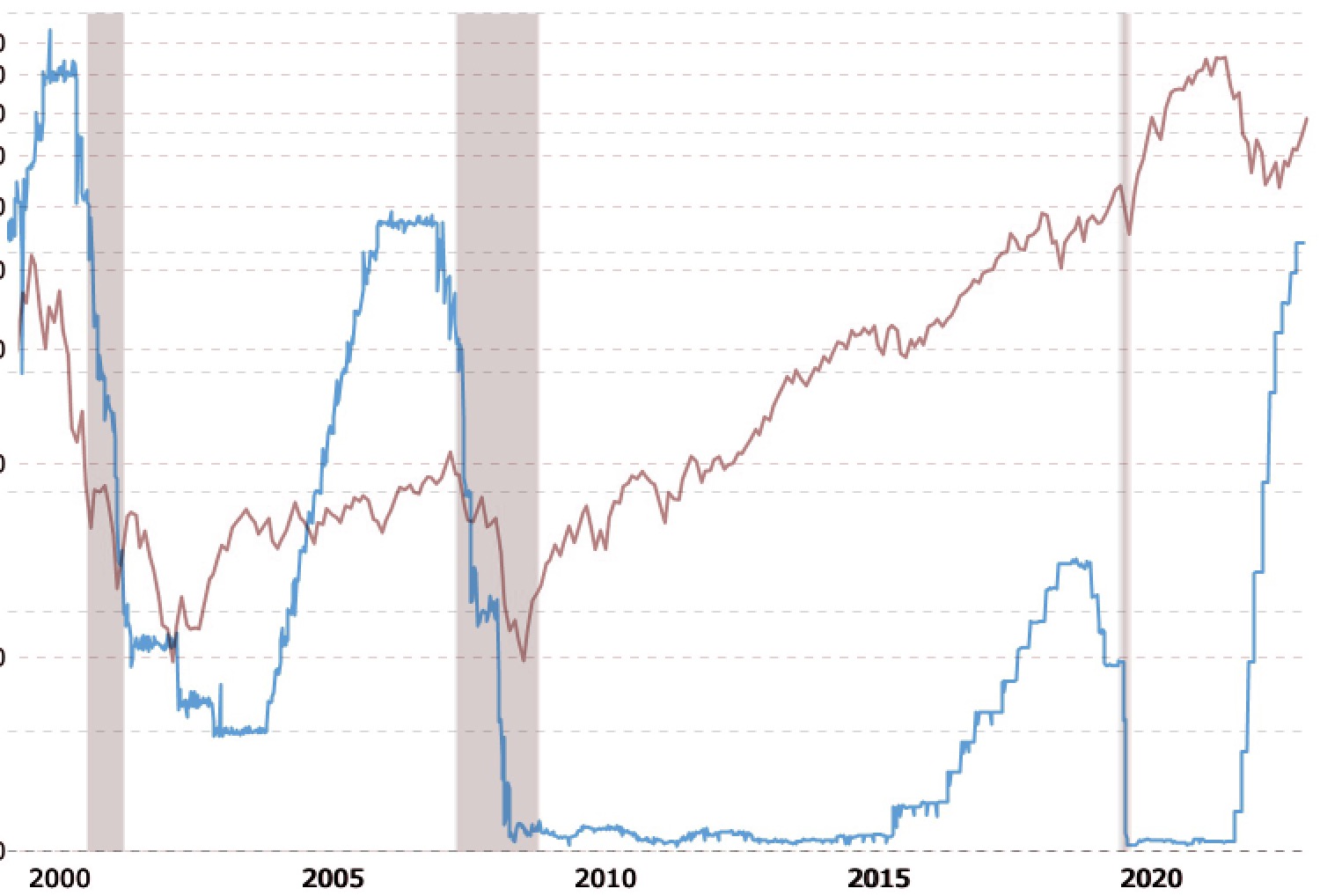
Less free-wheeling investment capital = less Silicon Valley.
You can sort of feel it, this fear. The sort of panicked hyping of the latest buzz words (Internet of Things, Blockchain, and now AI), just to stay afloat and continue to get investment $$$.
So, with this context, let's consider the recent Twitter and Reddit changes. If you think of the past 15 years as a "fuck around" phase for Silicon Valley, where money was easy to get from VCs and advertising, where you'd grow rapidly, hire thousands of engineers and managers, promise the sun and the moon to investors, advertising clients, and users alike.... I feel like now we've entered the "find out" phase. Money is drying up and suddenly you realize that hosting and serving images and video costs money. Allowing free third-party APIs that get called billions of times a day costs money. Paying your programmers and your rent costs money.
So if you're Elon Musk, what do you do?
- refuse to pay rent, refuse to pay for Google Cloud hosting
- try to bring in corporate account money by charging $1200/mo for API access
- try to go fremium by changing the Verfied badges into a "I paid $8/mo to be a reply-guy" badge
(And of course if you're Spez, you try to do the same, except with slightly more tempered.)
Meanwhile you have a bunch of messy code because you grew too big too fast to do it right, so when you start trying do these monetizing things, your site breaks. Of course, Elon Musk is fucking up and expediting this process in the most clumsy way possible, mostly likely because he's never had to face consequences in the past and are used to running roughshod over people and getting what they want anyway. But I think he's just an extreme example of the reality of things, which is that most of these mega Silicon Valley websites weren't particularly profitable in the first place, *especially* social media sites. After all, Amazon can still make money by oppressing its workers and forcing its sellers to operate on razor-thin margins, in tried-and-true monopoly tactics. Google is the OG and can still cruise along, making money from its advertising and all the corporations using their business services.
But what about social media? If we're done with fucking around and taking various shortcuts, who should actually be paying for the ability to make friends on the internet?
Well, let's start with what we want social media to be, if it's not trapped with the big companies? It needs to do something that email or a website doesn't do.
- ability to post and share images and video
- ability to comment and interact
- ability to follow people
- ability to filter and block
- some sort of dashboard aggregator
Do we need:
- privacy filters? Probably nice to have, but also depends on individual use case
- viral sharing abilities? Not sure. Depends on how much you want your stuff to be shown to strangers, who may then become your friends.
DW does most of this, though not the virality, and arguably not the image hosting. But yes, we probably need server mods and programmers to develop and maintain the service. We probably need to pay for social media in one way or another. Fediverse is hard because you're basically trading a corporate server mod for an individual, and as far as I can tell, every server instance is finicky in different ways. It needs to be something that the average person can click a few buttons, or download one app, and set up. It needs to have a robust free version but also be financially self-sufficient. Which is, egh, a lot.
Anyway, here's some ideas, from the most wild-and-crazy to the most likely:
- Bundle it with your Internet Service Provider. Imagine if, when you get Comcast or whatever, you are given an account to some sort of Fediverse instance, maintained by the ISP. Maybe you paid for the TV+10gb server space package or something. Migrating from one ISP to another should be as easy as bringing your cell phone number with you, which is to say ... probably a few extra clicks and a bit of a wait, maaaaaybe a slightly awkward phone call, but overall relatively painless. I can see ISPs competing to have the best features.
- Built-in Peer2Peer that either comes with your computer, or is a program that you download and install. Imagine BitTorrent or Napster, but for social media. (Or imagine minecraft server or opencanvas/drawpile). Benefit would be that you solve the server/bandwidth problem, because the server is your computer and the bandwidth is your upload speed. Downside would be that you'd always need to have to be spending computer cycles on it. (Though if SETI works, then so would this. Unless you move your computer out of internet range :X) But still, you download program, you run it, and it hosts all of your posts and comments on your computer and allows you to read other people's posts and comments. When someone wants to see an image on one of your posts, your computer (and other people who are seeding) is literally bittorrenting it over to them. This is something that was being explored during the Great Tumblr Exodus of 2017.
- Bring back OpenID and RSS. Well, they never went away, but people stopped using them. Remember when every website had RSS?* If there's a way to tack on a commenting protocol to RSS feeds, then people can choose where they want to post and how they want to read/follow/comment. You might have a bunch of different apps competing to offer the best posting or subscription/comment features. Keeping it open-access means that people aren't locked in walled gardens and can choose the functionality that they're willing to pay for, while hopefully still maintaining basic free functionality.
- Paid accounts. Discord and Tumblr now have this, and of course LJ/DW has had this forever. The trick, of course, is to not completely kneecap free account features as a way to encourage paid accounts, because that'd be enshittification all over again. I like that DW paid accounts are designed to also support the existence of free accounts, (I think one paid account supports 10 free accounts or smth), but DW also doesn't really do large-scale image or video hosting, which probably makes the cost more tenable. There also needs to be a social expectation of "pay for an account if you're able, bc this is a service you value and you'd rather be the client and not a product." At least, that's why I pay for DW, Tumblr, and Discord -- I don't actually use any of the paid features. I'm really keeping my fingers crossed for Tumblr -- hopefully there's enough people who come from an older generation of the internet (pre-2008, let's say) who still remembers that the internet isn't free.
Of course, all of these services or features would require hiring programmers and developing protocols or apps or whatever. ... Which would be most easily done by going to a Venture Capitalist and promising rapid growth and huge payouts. ¯\_(ツ)_/¯
------
* actually tumblr still has RSS, and DW still functions as an RSS reader. A bunch of the older webcomics still has RSS, too. As does major websites
Anyway, my core question is: if Social Media loses its current money streams, what might the future of social media look like?
Okay, let me back up a bit -- we all know that the internet isn't free, because *someone* has to pay for the server space and the computer programmers. First it was defense industry and universities, and then people either bought server space or you had a Geocities website that gave you 25mb for free but there was a banner ad, a floating ad, and a footer ad. Do y'alls remember waiting for images to load on dial-up? Paying for Email? I still remember when Youtube first showed up and I was like "but who's paying for all the server space and bandwidth of streaming video?" Or when I first got onto Tumblr and I was like "who's paying for all the image and video hosting?" Like, there *were* technological optimizations and innovations that made server space and bandwidth more efficient and cheaper, but at the end of the day, it still costs more money than goes into it from the user side.
For the past ~15 years, I feel like most of the internet is paid for by one of three things:
(a) advertising -- advertisers are promised extreme targeting and highly effective ad service. Basically that's what Google and Facebook made their money on.
(b) venture capital -- promising the venture capitalists that your company is going to be the next Facebook, use their money to run a massive deficit as you build your company, and do whatever it takes to convince the VCs to keep throwing money at you, for the promise of a future big payday
(c) corporate accounts -- provide a crucial service to a company flush with cash. These are the companies with 1000 employees, who are willing to pay Adobe or Slack or Google $600/year/user. Or provide server space for the company (AWS, Google Cloud)
This pushed companies to:
(1) grow as big as possible, as fast as possible (cutting corners and skirting regulations in the process.)
(2) lock in their users: give them sweet features but also create a walled garden. (good-bye, OpenID and RSS! hello, "you must log in to access...")
(3) once they've captured a giant user base, monetize monetize monetize. (usually with a combination of ads/selling user data, and going fremium -- charging users for previously-free services.)
This is the enshittification that Cory Doctorow talks about. This is what's created all these mega-walled gardens. Would you like to sell your soul to Amazon or Google? Facebook or Twitter? It also means that there's a whole generation of internet users who are used to websites and major services being free, who balk at the idea of paying for things like email or server space.
But things are starting to change. Advertising has hit a natural upper limit of usefulness -- spending more money on ads no longer yields more customers. (It's complicated). According to Spouse, Venture Capital is drying up, between the rising interest rates and the over-crowded startup landscape. There's still corporate accounts, but also some of them were startups, which would be the first to go if the internet bubble pops.
Here's a pic of the NASDAQ index (RED) crudely overlaid over the Federal interest rates (BLUE) of the last 20 years. Don't know if it proves Spouse right but the climb does come after the Fed dropped to zero interest rate during the 2008 crash.
Less free-wheeling investment capital = less Silicon Valley.
You can sort of feel it, this fear. The sort of panicked hyping of the latest buzz words (Internet of Things, Blockchain, and now AI), just to stay afloat and continue to get investment $$$.
So, with this context, let's consider the recent Twitter and Reddit changes. If you think of the past 15 years as a "fuck around" phase for Silicon Valley, where money was easy to get from VCs and advertising, where you'd grow rapidly, hire thousands of engineers and managers, promise the sun and the moon to investors, advertising clients, and users alike.... I feel like now we've entered the "find out" phase. Money is drying up and suddenly you realize that hosting and serving images and video costs money. Allowing free third-party APIs that get called billions of times a day costs money. Paying your programmers and your rent costs money.
So if you're Elon Musk, what do you do?
- refuse to pay rent, refuse to pay for Google Cloud hosting
- try to bring in corporate account money by charging $1200/mo for API access
- try to go fremium by changing the Verfied badges into a "I paid $8/mo to be a reply-guy" badge
(And of course if you're Spez, you try to do the same, except with slightly more tempered.)
Meanwhile you have a bunch of messy code because you grew too big too fast to do it right, so when you start trying do these monetizing things, your site breaks. Of course, Elon Musk is fucking up and expediting this process in the most clumsy way possible, mostly likely because he's never had to face consequences in the past and are used to running roughshod over people and getting what they want anyway. But I think he's just an extreme example of the reality of things, which is that most of these mega Silicon Valley websites weren't particularly profitable in the first place, *especially* social media sites. After all, Amazon can still make money by oppressing its workers and forcing its sellers to operate on razor-thin margins, in tried-and-true monopoly tactics. Google is the OG and can still cruise along, making money from its advertising and all the corporations using their business services.
But what about social media? If we're done with fucking around and taking various shortcuts, who should actually be paying for the ability to make friends on the internet?
Well, let's start with what we want social media to be, if it's not trapped with the big companies? It needs to do something that email or a website doesn't do.
- ability to post and share images and video
- ability to comment and interact
- ability to follow people
- ability to filter and block
- some sort of dashboard aggregator
Do we need:
- privacy filters? Probably nice to have, but also depends on individual use case
- viral sharing abilities? Not sure. Depends on how much you want your stuff to be shown to strangers, who may then become your friends.
DW does most of this, though not the virality, and arguably not the image hosting. But yes, we probably need server mods and programmers to develop and maintain the service. We probably need to pay for social media in one way or another. Fediverse is hard because you're basically trading a corporate server mod for an individual, and as far as I can tell, every server instance is finicky in different ways. It needs to be something that the average person can click a few buttons, or download one app, and set up. It needs to have a robust free version but also be financially self-sufficient. Which is, egh, a lot.
Anyway, here's some ideas, from the most wild-and-crazy to the most likely:
- Bundle it with your Internet Service Provider. Imagine if, when you get Comcast or whatever, you are given an account to some sort of Fediverse instance, maintained by the ISP. Maybe you paid for the TV+10gb server space package or something. Migrating from one ISP to another should be as easy as bringing your cell phone number with you, which is to say ... probably a few extra clicks and a bit of a wait, maaaaaybe a slightly awkward phone call, but overall relatively painless. I can see ISPs competing to have the best features.
- Built-in Peer2Peer that either comes with your computer, or is a program that you download and install. Imagine BitTorrent or Napster, but for social media. (Or imagine minecraft server or opencanvas/drawpile). Benefit would be that you solve the server/bandwidth problem, because the server is your computer and the bandwidth is your upload speed. Downside would be that you'd always need to have to be spending computer cycles on it. (Though if SETI works, then so would this. Unless you move your computer out of internet range :X) But still, you download program, you run it, and it hosts all of your posts and comments on your computer and allows you to read other people's posts and comments. When someone wants to see an image on one of your posts, your computer (and other people who are seeding) is literally bittorrenting it over to them. This is something that was being explored during the Great Tumblr Exodus of 2017.
- Bring back OpenID and RSS. Well, they never went away, but people stopped using them. Remember when every website had RSS?* If there's a way to tack on a commenting protocol to RSS feeds, then people can choose where they want to post and how they want to read/follow/comment. You might have a bunch of different apps competing to offer the best posting or subscription/comment features. Keeping it open-access means that people aren't locked in walled gardens and can choose the functionality that they're willing to pay for, while hopefully still maintaining basic free functionality.
- Paid accounts. Discord and Tumblr now have this, and of course LJ/DW has had this forever. The trick, of course, is to not completely kneecap free account features as a way to encourage paid accounts, because that'd be enshittification all over again. I like that DW paid accounts are designed to also support the existence of free accounts, (I think one paid account supports 10 free accounts or smth), but DW also doesn't really do large-scale image or video hosting, which probably makes the cost more tenable. There also needs to be a social expectation of "pay for an account if you're able, bc this is a service you value and you'd rather be the client and not a product." At least, that's why I pay for DW, Tumblr, and Discord -- I don't actually use any of the paid features. I'm really keeping my fingers crossed for Tumblr -- hopefully there's enough people who come from an older generation of the internet (pre-2008, let's say) who still remembers that the internet isn't free.
Of course, all of these services or features would require hiring programmers and developing protocols or apps or whatever. ... Which would be most easily done by going to a Venture Capitalist and promising rapid growth and huge payouts. ¯\_(ツ)_/¯
------
* actually tumblr still has RSS, and DW still functions as an RSS reader. A bunch of the older webcomics still has RSS, too. As does major websites
no subject
no subject
yeah! Firefox used to have a one-click to get to the rss feed of a site, too. Since I use DW as my RSS feed readers though, I try not to overburden it with too many RSS feeds, and I'm careful about curating my flist (some tumblrs move too fast and end up spamming my DW feeds), though I actually just added the NYT World News feed yesterday:![[syndicated profile]](https://www.dreamwidth.org/img/silk/identity/feed.png) nyt_world_feed :)
nyt_world_feed :)
no subject
Peer to peer does have its promise. Soulseek has a version of that with its chatrooms in addition to the file downloading. Of course, being a place where people go to get bootleg music the quality of chat is revolting. I think if we want that to take off, it would require a lot of moderation and that costs money.
Fediverse seems to be where a decent amount of people are going to post-Reddit but as we can see from the reaction to Lemmy (the developers of the code are Tankies), it is not an easy solution either.